“A strong start, but uncertainty is growing and results are levelling off”
Wondering how your pension is performing after the first quarter of 2026?
Take a look at your new value statement in the ‘My archive’ section on my-Shell pension. In the interview below, Jeroen Roskam from Achmea Investment Management explains how the first quarter of 2026 unfolded and what this means for investments.

At SNPS, you and your employer both contribute to your pension. Those contributions are paid into your personal pension pot and invested for you. Investing offers opportunities for growth, but also involves risks: the value of your pension may increase or decrease.
Fluctuations in interest rates affect the financial markets and your (expected) pension payments. We monitor these developments closely and our investment policy remains focused on the long term.
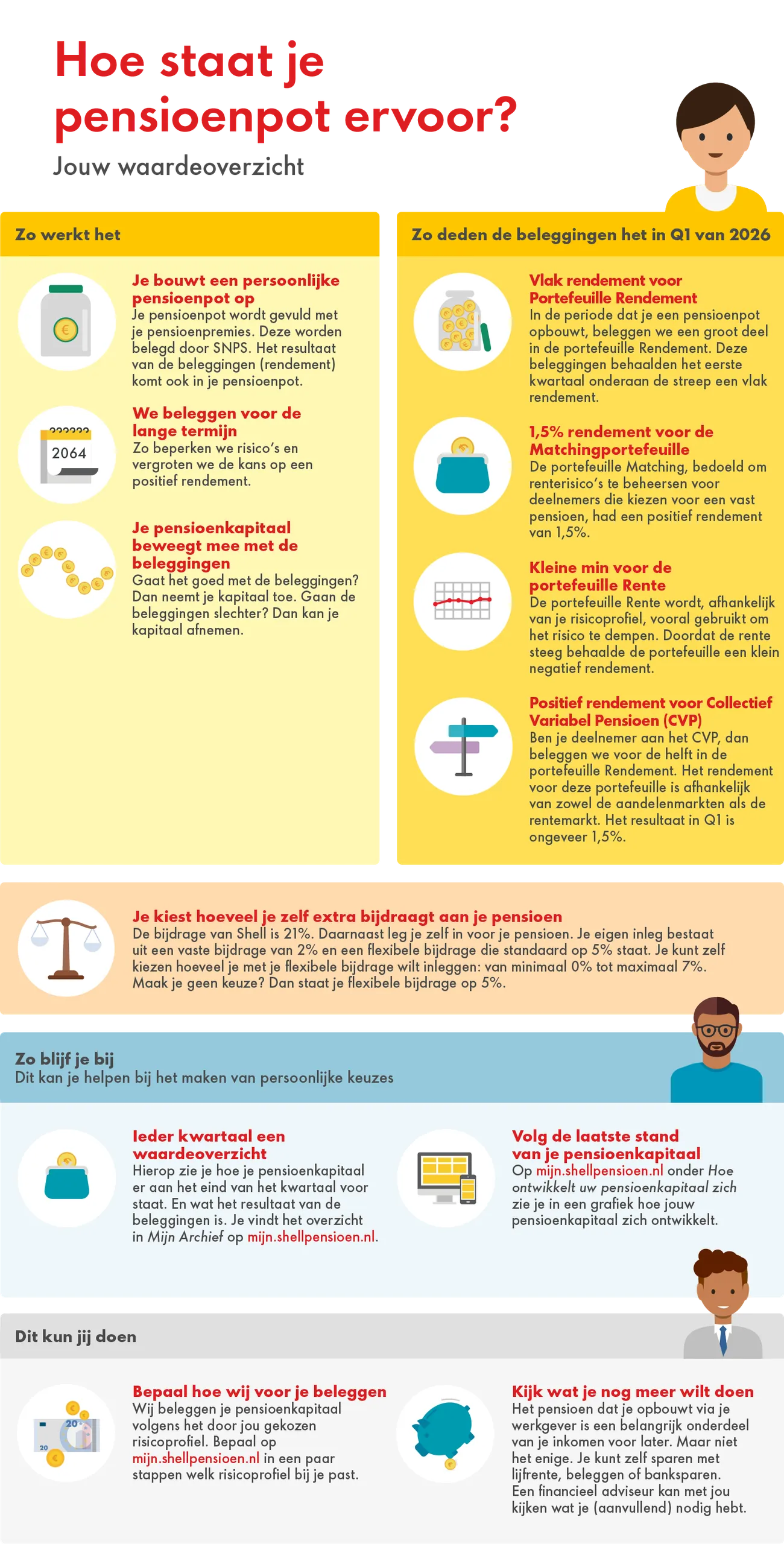
Text continues below the infographic.
Here’s what happened with the economy
“The global economy remained resilient in the first quarter of 2026, despite rising geopolitical tensions and trade conflicts. In January, both the US and eurozone economies continued to grow steadily, with only a limited impact from political unrest. In February, uncertainty increased after the US Supreme Court struck down trade tariffs and the government introduced alternative levies. At the end of February, the conflict in the Middle East escalated further, with an attack on Iran and reciprocal retaliations. This had major consequences for the global energy supply, as oil and gas exports via the Strait of Hormuz largely ground to a halt.”
Here’s what happened with interest rates and inflation
“Central banks largely stuck to their current course in the first quarter. The US Federal Reserve (Fed) left interest rates unchanged in January and is expected to appoint a new leader in May, with Kevin Warsh as the intended successor to Jerome Powell. The European Central Bank stated that eurozone inflation is in line with the target and kept the deposit facility rate at 2% in February (this is the interest rate banks receive when making overnight deposits with the central bank). However, due to the deteriorating geopolitical situation, inflation risks increased and the interest rate outlook changed. Whereas markets had previously anticipated stability, they are now factoring in multiple interest rate rises.”
Here’s what happened in the financial markets
“The financial markets started the year on a positive note, with positive returns on both safe-haven and riskier bonds and rising share prices. Emerging market equities, in particular, performed strongly. In February, volatility increased and commodity prices rose. The picture changed in March due to the conflict in the Middle East. Energy prices soared, with crude oil rising by more than 60 percent and gas prices in Europe rising sharply. Other asset classes came under pressure: share prices fell and both interest rates and risk premiums rose. The US dollar appreciated against the euro during this period.”
In short, the first quarter of 2026 saw considerable volatility in the financial markets once again. These volatile periods are part and parcel of investing. It is worth noting that Shell Pension invests for the long term and that our investment portfolios have a good spread. Furthermore, we use scenario analyses to assess the possible outcomes of our investment policy so that we are well prepared for various market conditions.
Your pension pot after the first quarter of 2026
How has your pension pot been affected by the investment results and by political and economic developments?
Return portfolio: flat result
“In the first quarter, this portfolio ultimately generated a return of around zero percent. Until the escalation surrounding Iran at the end of February, the portfolio was still showing a return of over 5%. That changed after this date. Share prices, in particular, fell. As the return for this portfolio depends mainly on the return on the equity markets, we see this movement reflected directly in the result.
Matching portfolio: 1.5% return, Interest portfolio: a small minus
“The Matching portfolio, which is designed to manage interest risks for participants who have opted for a fixed pension, achieved a positive return of over 1.5%. The Interest portfolio achieved a small negative return (-0.28%). Returns on both portfolios came under pressure due to the unrest in the Middle East, as bond rates rose amid fears of higher inflation. This caused bonds to fall in value. This had a particular impact on bonds with shorter maturities held in the Interest portfolio.”
The CVP portfolio achieved a positive return of around 1.5%
“If you are (almost) retired and have opted for a variable pension, we invest your pension capital via the Collective Variable Pension (CVP) portfolio. Approximately 50% is invested in the Return portfolio. Interest rate trends also determine the level of your pension payments. Interest rates rose particularly sharply in March, which on balance is favourable for the CVP portfolio.
Latest news
Blijf op de hoogte van het laatste nieuws en de ontwikkelingen rondom jouw Shell pensioen.